
The 1st full moon of 2026 rises tonight! Here’s what to expect from January’s supermoon Wolf Moon

By Anthony Wood published
The first full moon of 2026 has arrived.
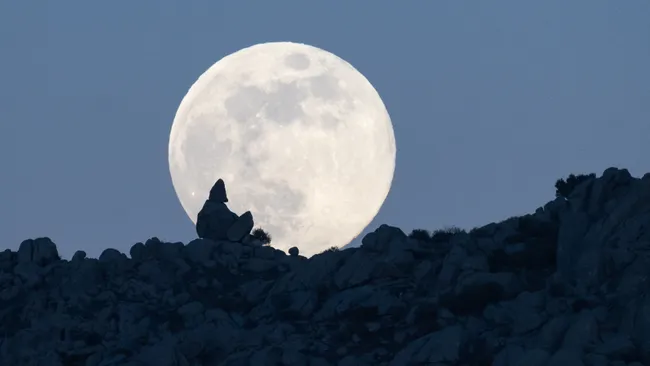
A Wolf Moon creeps over the rock formations of Sierra de Guadarrama in January 2025. (Image credit: Marcos del Mazo/LightRocket via Getty Image)
The January 2026 full moon is upon us! Here’s what to expect when the “Wolf Moon” prowls over the horizon tonight, kicking off a spectacular natural light show as the first full moon (and supermoon) of 2026.
A full moon occurs when the moon sits opposite the sun in Earth‘s sky — an event that occurs just once in each of its 27-day recurring orbits — causing the lunar disk to appear fully-lit from our perspective. January’s full moon officially reaches peak illumination at 5:03 a.m. EST (1003 GMT) on Jan. 3, though the lunar disk will appear practically full to the casual observer on the surrounding nights. Local moonrise and moonset times will depend on your location.
January’s full moon is known as the Wolf Moon, in reference to the hungry predators that have been known to howl during the long winter nights. It is also sometimes known by its Anglo-Saxon name, the “Moon After Yule”, according to TimeandDate and as the “Severe Moon” by North America’s indigenous Dakota people to reflect the bitter cold of the month, per the Old Farmers Almanac.
This month’s full moon phase coincides with the moon’s closest approach to Earth — a point in its orbit called perihelion — giving rise to a beautiful supermoon that can appear 30% brighter and 14% larger than the most distant full moon of the year. January’s supermoon is the last in a string of four consecutive supermoons. After that, we’ll have to wait until Nov. 24, 2026, to see another!
When to see the “Wolf Moon” rise
Look to the eastern horizon at dusk on Jan. 2 to watch the “Wolf Moon” rise shortly before sunset local time. It will appear particularly large while close to the horizon thanks to a phenomenon called the “moon illusion“, a visual effect that makes low-hanging moons seem oversized.
You may notice this effect even more at sunset on the following day (Jan. 3), when the satellite will rise in a darker sky shortly after the sun sets. You may also notice the moon take on an orange-yellow hue as it sits close to the horizon, as the prolonged journey through Earth’s atmosphere scatters the bluer wavelengths of reflected light, while allowing redder wavelengths to pass relatively unhindered.
| New York | 5:03 a.m. EST |
| London | 10:03 a.m. GMT |
| Tokyo | 7:03 p.m. JST |
| Beijing | 6:03 p.m. CST |
| Sydney | 9:03 p.m. AEDT |
On Jan. 3, bright Jupiter will shine less than 4 degrees to the right of the lunar disk. For context, the width of your three middle fingers held at arm’s length accounts for 5 degrees in the night sky.
Breaking space news, the latest updates on rocket launches, skywatching events and more!
Why not grab your camera and try to snap a picture of the first full moon of the year using our handy guide to imaging Earth’s natural satellite? You may also want to check out our roundups of the best cameras and lenses for astrophotography to ensure that you’re prepared to capture everything that the 2026 night sky has to offer.
No comments yet.
Add your comment